
Don’t Shoot the Messenger RNA
mRNA is misunderstood, but pretty miraculous

TL;DR: mRNA technology has been decades in the making, and has exciting applications beyond COVID, including fighting cancer.
If you left the pandemic with the impression that mRNA vaccines were invented in a rush in 2020 to respond to a global emergency, you’re not alone.
But in reality, “warp speed” was true only for COVID vaccines, not mRNA science itself.
Messenger RNA was discovered in the early 1960s. Scientists were experimenting with ways to deliver it into cells in the 1970s. mRNA flu vaccines were tested in mice in the 1990s, and human trials for an mRNA rabies vaccine began in 2013. By the time COVID emerged, the platform had already been under development for decades.
What is Messenger RNA (mRNA)?
Very simply, mRNA is a molecule that gives instructions to the cell for what proteins to make (relaying the instructions from your DNA). We make our own mRNA all the time. Once this mechanism was understood, scientists realized it might be useful for making any protein the body might need, like making our own medicine from within.
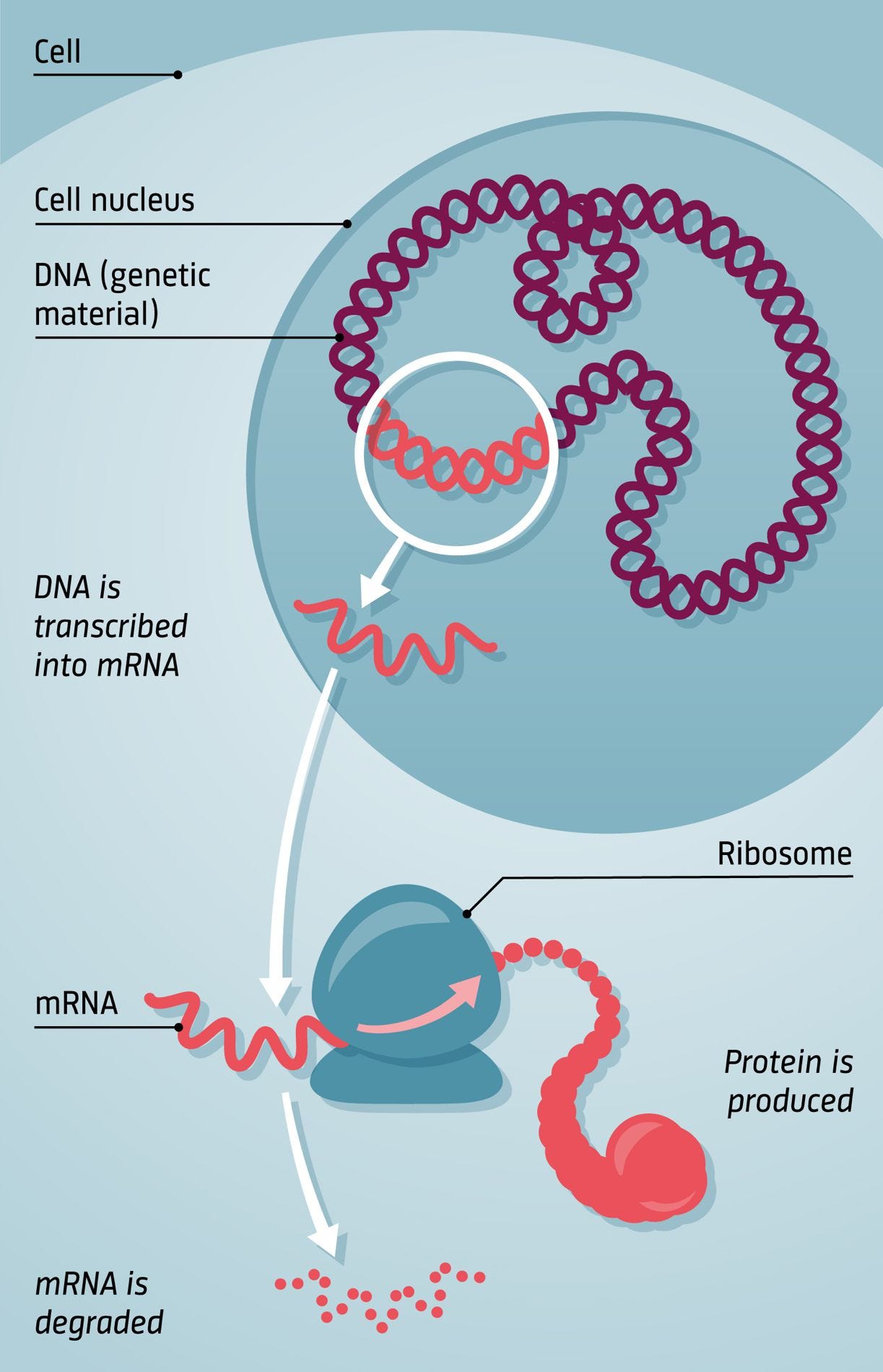
Image: Anne Seeger, SCNAT (CC BY 4.0)
The central challenge to using mRNA in medicine was not conceptual, but practical. mRNA is fragile, and our bodies are designed to break down stray RNA quickly. For many years, scientists struggled to get mRNA into cells intact long enough for it to deliver its instructions. The breakthrough was the development of lipid nanoparticles--tiny fatty particles that protect the mRNA and help it enter cells. Another challenge was modifying the RNA to avoid an over-reaction by the immune system from introducing mRNA fragments-a breakthrough that won Katalin Kariko and Drew Weissman the Nobel Prize in 2023.

Medicine Nobel laureate Katalin Karikó with her donation to the Nobel Prize Museum – her favourite pipette. Nobel Prize Outreach. Photo: Anna Svanberg
With mRNA vaccines, the fat-bubble-protected mRNA enters muscle and other cells around the injection site. It then provides temporary instructions to produce a harmless viral protein (not the whole virus). For SARS-CoV-2 vaccines, these instructions made a piece of the signature spike protein. The immune system responds to that protein and makes antibodies to recognize the same protein if it sees it again. The mRNA is then broken down within days and cleared out as cellular waste.
That brings us to some of the most common mRNA myths:
Myth 1: mRNA changes your DNA
mRNA never enters the nucleus of the cell, where your DNA resides. It operates in the cytoplasm (the jelly-like substance that fills the inside of a cell), delivers instructions, and degrades. It has no way to integrate into your genome or change your DNA.
(If mRNA could rewrite our DNA, we may have cured a long list of inherited diseases by now).
Myth 2: mRNA vaccines infect you with the disease
With mRNA vaccines, your cells temporarily produce one viral protein fragment. Your immune system trains its response on that fragment. That’s the whole thing. There is no live virus, no weakened virus, no possibility of infection. mRNA hands your immune system a “wanted” poster for the virus, but it doesn’t let any criminals in the door.
Myth 3: mRNA is brand new and untested.
As described above, mRNA vaccines may be a new commercial product, but they are not a new scientific idea. COVID-19 accelerated funding, trials, and manufacturing capacity for this technology, but it did not invent the mRNA platform from scratch. The first human clinical trials of mRNA vaccines (for rabies) began in 2013. What is true is that prior to 2020, trails were ongoing and no mRNA vaccine had yet been approved for therapeutic use in humans. The pandemic paved the way for pushing forward logistics at “warp speed,” but no corners were cut in evaluating the safety and effectiveness of the vaccines themselves.
Myth 4: mRNA vaccines cause “turbo cancer”
There is no evidence that mRNA vaccines cause cancer, and cancer rates did not increase during the pandemic or after the roll-out of mRNA vaccines. To the contrary, we have evidence that mRNA technology may be a great tool in the fight against cancer (see below).
More than COVID
mRNA technology is not all about COVID. It’s a flexible technology that’s already being applied in some amazing ways.
Helping You Kill Your Own Cancer
Imagine you could train your own immune system to kill cancer cells. This is one of the most exciting frontiers in science right now. mRNA cancer “vaccines” work differently from infectious disease vaccines—the mRNA gives instructions for proteins that are only found in cancer cells, so the immune system can learn to recognize and attack the cancer cells. These vaccines aren’t to prevent cancer (yet), but are personalized to target the patient’s own tumour cells. mRNA cancer vaccines are showing great promise in clinical trials for difficult-to-treat cancers such as melanoma, pancreatic cancer, and brain cancer. I imagine we all know someone who has suffered from one of these terrible illnesses with little hope of effective treatment. This is potentially very good news.
Earlier this year, we also saw results suggesting that mRNA COVID vaccination may make cancer immunotherapy more effective, which I covered here:
Can mRNA Vaccines Supercharge Cancer Treatment?

TL;DR: Patients who received a COVID-19 mRNA vaccine within 100 days of starting immune checkpoint inhibitor (ICI) therapy survived almost twice as long. The mRNA vaccine appears to activate immune responses that work in synergy with the therapy to attack and kill tumor cells.
Overall, mRNA technology is proving an exciting innovation for improving cancer survival.
More vaccines
In addition to the COVID-19 vaccines, an mRNA RSV vaccine from Moderna has also been approved. Trials at different stages are underway for mRNA vaccines against HIV, Zika, cytomegalovirus, and rabies. But among the most important mRNA vaccines may be the ones developed for influenza. Moderna has an mRNA flu vaccine that recently completed Phase 3 trials, as well as a combined flu and COVID vaccine, which was just recommended for approval by the European Medicines Agency.
One big advantage of mRNA vaccine technology is the ability to make vaccines quickly, within weeks. If a new virus emerges, mRNA instructions for that viral protein can be easily tweaked, making the process much faster than methods that require growing viruses in eggs or cell cultures. Flu vaccines have traditionally relied on egg-based production that takes about six months from strain selection to administering a vaccine (assuming we have enough chicken eggs). This time could mean everything in the event of a new pandemic threat. While the threat of pandemic flu is always with us, the recent jump of highly pathogenic avian flu (H5N1) from birds to mammals like cattle and ongoing widespread transmission makes this at least slightly more likely at the moment. The good news is that a Phase 3 clinical trial is underway for an mRNA-based H5 pandemic influenza vaccine candidate, with financial investment from the Coalition for Epidemic Preparedness (CEPI). If successful, the vaccine would serve as a platform for rapid response should a new pandemic influenza emerge.
Cloudy Skies Ahead for mRNA Innovation
Despite this great promise, the road ahead for further mRNA innovations to improve human health is not assured. Recent regulatory confusion, including the FDA’s recent refusal to review Moderna’s new mRNA flu vaccine for unclear reasons and later abrupt reversal of this decision, has unsettled companies that must make decisions about long-term investments in this technology. Federal funding for mRNA research has also come under threat in the US in the past year. With so many potential applications of mRNA technology, this type of disinvestment due to policy uncertainty would be a real tragedy.
Bottom Line:
mRNA technology was a long time in the making and is poised to transform medical therapeutics such as vaccines, cancer immunotherapy, cystic fibrosis, and more. The platform’s core advantage--that it delivers instructions rather than a finished drug-- means it can, in theory, be adapted to almost any situation in which a specific protein is needed.
So, let’s all give mRNA some love and not shoot this “messenger” because of the politicization of COVID-19. Doing so would be shooting ourselves in the foot….
Stay well,
Jenn
This post is a collaboration with Data for Health, Those Nerdy Girls, and the Dartmouth International Vaccine Initiative
Further reading:
Measuring the Impacts of RNA Vaccine Research and the Consequences of Defunding
How do we know mRNA vaccines are safe and effective? An Explainer.