
A New (and Possibly Better) Flu Vaccine Coming Your Way
Moderna's mRNA flu shot outperformed the standard vaccine in trials and just got the blessing of the US FDA's vaccine advisory committee.

TL;DR: Moderna’s mRNA flu vaccine was more effective than standard flu shots in adults 50 and over and may be available in the US this fall.
The US FDA vaccine advisory committee voted unanimously last month to recommend Moderna’s mRNA influenza vaccine for adults aged 50 and over.
The Good
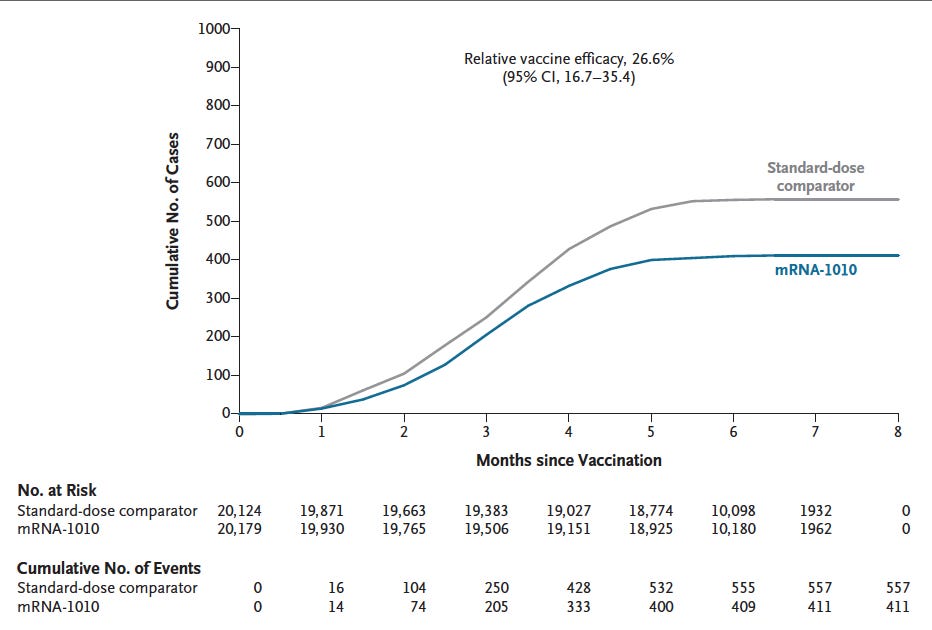
The mRNA flu vaccine lowered the risk of flu infection by 26.6% compared to the standard flu vaccine.
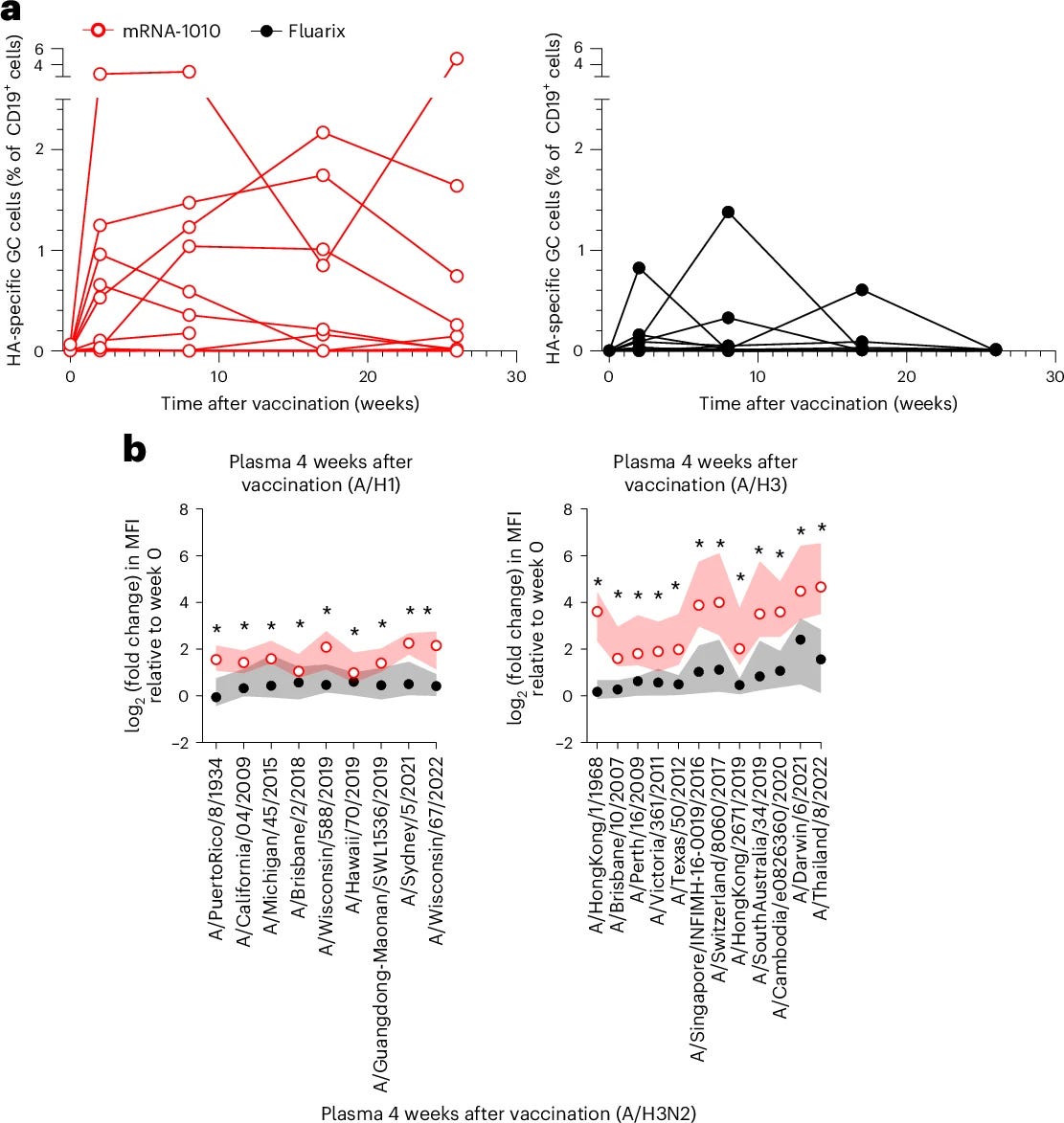
The mRNA vaccine produced a stronger and more diverse antibody response, which may help it neutralize more flu variants.
mRNA vaccines can be produced much more quickly than traditional flu vaccines, most of which are still grown in eggs.
This means less time between strain selection and production, and less chance of a mismatched vaccine.
The Less Good
There were more side effects on average with the mRNA vaccine, such as a sore arm, headache, fatigue, and body aches, compared to standard flu vaccines.
It’s not “just a flu”
A quick reminder that the flu is not just a bad cold. Not only does it feel like getting hit by a truck, it can also cause serious complications like pneumonia and sepsis, and causes hundreds of thousands of US hospitalizations and tens of thousands of deaths each year. While current flu vaccines reduce the risk of severe disease, effectiveness is not as high as it could be (typically between 30-60%), often because the vaccine doesn’t match circulating strains given the lag between choosing strains and production. A new vaccine that elicits stronger immune responses AND is better matched to the circulating strains could be a big advance.
Quick mRNA refresher
The concept of messenger-RNA (mRNA) vaccines is simple yet elegant. Rather than needing to make viral proteins in an egg or a cell culture to put in a vaccine, the mRNA gives instructions (or messages) to our own cells to make a protein that looks like part of the virus we want to target. Our immune system then trains itself to recognize these viral proteins so it can quickly swoop into action if it sees the real thing. The mRNA itself is broken down within days and cleared out of the body. Amaze amaze amaze.
Read more about this remarkable technology along with some debunking of common myths in this previous post:
Don’t Shoot the Messenger RNA

TL;DR: mRNA technology has been decades in the making, and has exciting applications beyond COVID, including fighting cancer.
Speaking of the miracle of mRNA, please enjoy this pic of my recent Nerdy fangirl moment, meeting one of pioneers of mRNA technology, Nobel Prize winner Katalin Karikó (along with her also super talented Olympic champion daughter Susan Francia) when she received an honorary degree at Oxford in June. 🤩

The FDA committee vote on the mRNA flu vaccine was based on clinical trial data submitted by Moderna for review. The primary Phase 3 trial enrolled over 40,000 people in 11 countries during the 2024-25 flu season. This was a bad flu season...which I remember since I spent Christmas of 2024 flat on my couch with the flu, catching up on my Netflix queue.
But the upside of a bad flu season is that the trial doesn’t have to go on for too long to get enough cases to estimate results—so the trial actually ran for one flu season instead of two as originally planned.
The trial compared the mRNA vaccine to a standard-dose flu vaccine (Fluarix). Why not test against a placebo? 1) When we already have an effective vaccine, it’s not considered ethical to test a new vaccine against a placebo, since half the people would be left unprotected. 2) We also don’t necessarily want to know whether a new vaccine works compared to nothing, but whether it works as well or better than the ones we already have.
The mRNA flu vaccine was not just as good as the standard flu vaccine—it was better.
The mRNA vaccine lowered the risk of infection by 26.6% compared to the standard flu vaccine. Again, this is measuring an improvement over the existing vaccine rather than a comparison to nothing, so this relative improvement is more impressive than the number might sound. The mRNA vaccine also provided better protection against hospitalization, emergency department, or urgent care visits, although these numbers were low overall and not the primary study endpoints.
The bad news: People taking the mRNA vaccine reported more mild to moderate side effects on average like a sore arm, fever, headache, and fatigue. This is the increased “reactogenicity” of mRNA vaccines that many people know from their mRNA COVID-19 vaccines. These side effects were actually milder among older people (>65)—likely because we don’t mount as strong of an immune response with age.
Maturing into Better Antibodies
Another study did a deeper dive into the immune response of adults (aged 20-50) receiving the Moderna mRNA flu vaccine compared to a standard influenza vaccine. Besides examining antibodies in blood, the researchers also sampled fluid from lymph nodes so they could examine antibody production in “germinal centers” — the places where new immune cells work to refine their antibodies to better match their target. The longer germinal centers stay active, the more precise and diverse the resulting antibodies become. They found that the mRNA vaccine induced a stronger immune response and a broader, more diverse set of antibodies against the flu compared to the standard vaccine. Antibody maturation in the germinal centers continued for at least 6 months post-vaccination in some of the mRNA participants, which didn’t happen with the standard vaccine. This expanded antibody diversity may mean broader protection across different strains. This could also make mRNA technology a better bet for the elusive dream of a “universal” flu vaccine (yes please!).
OK this sounds great. But wasn’t there some drama about the FDA refusing to review Moderna’s mRNA flu vaccine?
You are remembering right—there was a minor kerfuffle back in February when the then Center for Biologics Evaluation and Research (CBER) Director Vinay Prasad overruled FDA staff and issued a “refusal to review” for Moderna’s application. His justification was that the vaccine was not tested against the high-dose traditional vaccine for those over age 65. But the FDA had previously agreed to Moderna’s study design with the standard dose, so the refusal was seen as unfairly moving the goal posts based not on science but on politicized anti-mRNA sentiment. Moderna contested this refusal, and within two weeks, Vinay Prasad was the one overruled. Perhaps “all’s well that ends well,” but in an industry that relies on transparency and predictability of regulatory processes to make huge investments, introducing this type of political uncertainty is bad news for the future of life-saving research and drug development.
Does this drama cast any doubt on the efficacy of the vaccine?
From my view, it shouldn’t. There were no questions about the safety or efficacy of the vaccine against the standard dose comparator. Moderna’s Phase 3 trial took place in eleven different countries, not all of which recommend high-dose vaccines for 65-and-overs. Furthermore, many adults in the US over age 65 still get a standard-dose vaccine instead of high-dose flu vaccine, so it’s a valid comparator for real world use. Because of the potential advantage of much faster production of mRNA vaccines, it’s also worth knowing how well mRNA works compared to the most commonly used flu vaccine.
That said, I agree it’s still an important clinical question how the mRNA vaccine performs compared to high-dose versions in older populations. Higher-dose flu shots are recommended for people aged 65 and over because people don’t mount as good of an immune response to vaccination as we get older due to immunosenescence (a fancy word for age-related immune decline).
Moderna has published data from other Phase 3 trials comparing the mRNA vaccine to high-dose versions in older populations. These trials were smaller and focused on “immunogenicity” as the endpoint rather than on confirmed flu infections. Reassuringly, they found equal or better immune responses from the mRNA vaccine compared to the high-dose flu vaccine. As part of the review decision, the approval for ages 65 and older requires Moderna to conduct a phase 4 “post-marketing” study to evaluate vaccine efficacy against infection compared to the high-dose vaccine. So Moderna will have more time to collect data on this specific population without slowing down the overall approval and availability of the new vaccine. If that new data changes the picture somehow (which doesn’t seem likely based on the immunogenicity data), the approval for that age group could be removed at a future date.

A Flu-COVID combination shot
Moderna has also received approval in the European Union for a one-shot combination of the mRNA flu vaccine and the mRNA COVID vaccine. In the data behind that approval, the combo vaccine elicited higher immune responses to the flu compared to the high-dose flu shot in ages 65 and over. Sadly, this flu-COVID combo shot will not be available in the US this season, as Moderna withdrew their application to the FDA in May 2025 “in consultation with” the US FDA, coinciding with other federal moves away from mRNA technology. Moderna suggested that they would resubmit their US application for the combination shot once they had more data for the flu component, so this recent positive signal from the FDA may pave the way for an eventual Flu-COVID combo shot in the US.
The FDA still has to give final approval to license the new mRNA flu vaccine, which is expected by August 5th. While the FDA typically agrees with the advisory committee’s recommendation, these are uncertain times, so stay tuned.
If all goes well, the vaccine is expected to be ready for the 2026-27 flu season (for over 50s).
Stay well,
Jenn
This post is a collaboration with Data for Health, Those Nerdy Girls, and the Dartmouth International Vaccine Initiative.