
Does Coffee Really Prevent Dementia?
I *love* my coffee, but I’m not convinced.

TL;DR: Drink your coffee for pleasure, not for dementia prevention.
Some studies are custom-made for headlines. Especially when it’s something beloved in our daily lives, like coffee, we’re prone to hit the “I believe” button (also known as confirmation bias). While this may drive clicks and social media shares, it’s not so good for helping us discern good evidence from bad.
At this rate of coffee intake, I will live forever
You probably saw recent media coverage suggesting that drinking coffee (but not decaf) may lower your risk of dementia.
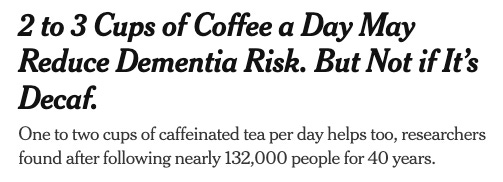
One of about a million headlines on this study
Naturally, this piqued my interest, as both a coffee lover and data nerd. But let’s look under the hood.
The Basics
The study, published in JAMA, followed 131,821 people from two large US cohorts of health professionals followed up for up to 43 years, with 11,033 dementia cases developing overall.
Main Results: People who drank 2-3 cups of caffeinated coffee had an 18% lower relative risk of a dementia diagnosis, compared to people who drank no coffee. Decaf coffee intake was not associated with dementia.
The Set-up
The study is what we call “observational,” meaning we observe people’s health behaviors and subsequent health out in the wild, without any specific intervention. People “choose” their own exposures, like whether they drink coffee, tea, matcha lattes, or none of the above. They report what they eat and drink in a periodic questionnaire. This is different from an experimental design, where the “exposure” or “treatment” of interest is carefully measured and randomly assigned by researchers (like a clinical trial of a new drug).
Randomized studies are generally preferred for causal inference because they help ensure that people getting the treatment are similar in every other way to those who don’t. That means we can be much more confident that the treatment caused any differences in subsequent health.
Observational studies try to mimic this experimental design in spirit, comparing groups of people with and without exposure (in this case, coffee). But since coffee drinking is not randomly assigned, this is quite tricky, even with fancy statistical adjustment. People may drink more coffee because they work night shifts, or because they like to show off their fancy Starbucks drinks. People may drink less coffee because it makes their heart race, or because they can’t afford fancy Starbucks drinks. Either way, it’s safe to say that whether we drink coffee is not determined by a coin flip.
So despite my confirmation bias, my baseline level of skepticism about this headline was high, for many of the reasons articulated in this great post by Dr. Céline Gounder. But, I’m always curious and willing to be persuaded by good data analysis.
Reader, I was not persuaded.
🚩 Some Red Flags
One important data check in any study is to show readers how similar the “exposed” and “unexposed” groups are on other characteristics. Ideally, they are very similar except for coffee drinking, like an experiment. In this study….not so much.
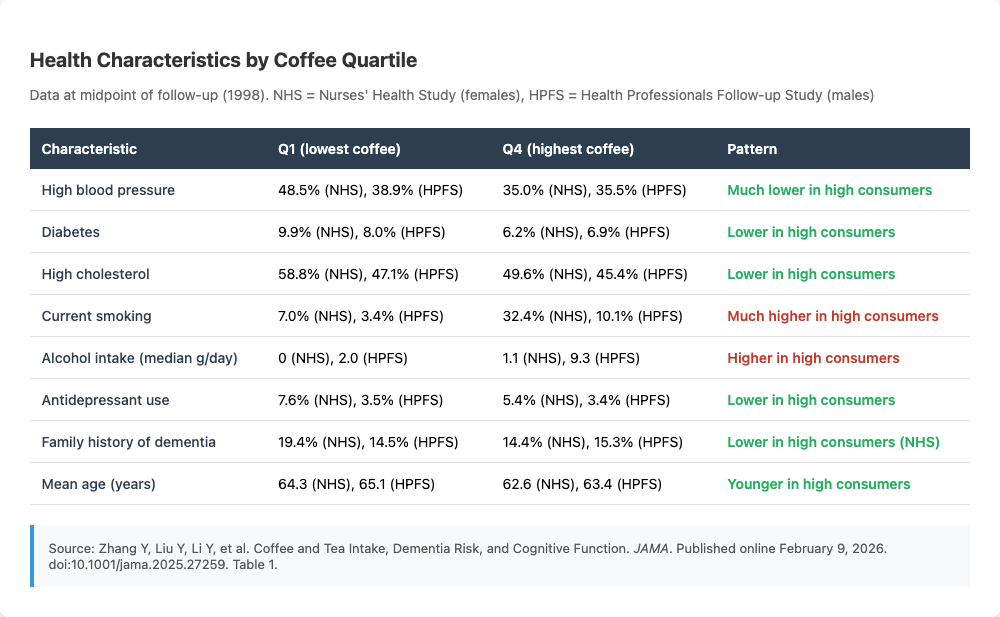
🚩 Coffee Drinkers Were Already Healthier
High coffee consumers in this sample were:
❌ Much more likely to currently smoke (bad for dementia)
❌ Drink more alcohol (potentially bad)
✅ Less likely to have hypertension (protective)
✅ Less likely to have diabetes (protective)
✅ Less likely to have high cholesterol (protective)
✅ Less likely to use anti-depressants (protective)
✅ Less likely to have a family history of dementia (protective)
✅ Younger (protective)
These differences are a pretty big deal. Hypertension, diabetes, and high cholesterol are all major risk factors for dementia--especially vascular dementia. The low coffee consumption of those with cardiovascular risk factors may be because people with heart or blood pressure problems are often advised to cut back on caffeine. This “unhealthy quitter” effect is also a common issue in studies of alcohol consumption and health.
🚩 The Smoking Paradox
Coffee drinkers were A LOT more likely to be current smokers. In the Nurses’ sample:
Lowest coffee consumption group: 7% current smokers
Highest coffee consumption group: 32% current smokers
Say whaaaaat?!

Smoking is not good for your brain. So why would heavy coffee drinkers have less dementia despite smoking way more? To me this suggests there is something very strange going on with this analysis. Sadly, the there isn’t a lot of detail provided to help us better understanding these anomalies (also not comforting). There are a few possibilities, but one that I think is most important— the study failed to account for competing risks.
You Can’t Get Dementia if You Die From Lung Cancer
Over 43 years of follow-up, lots of people die before they can develop dementia. The study treats death as “censoring”—you just exit the analysis, but never have the opportunity to count as a dementia death. Heavy smokers (who also drink more coffee) are more like to die early.
If heavy coffee drinkers die from heart attacks or cancers at 65, they never make it to the age where dementia develops (typically 75+). They get counted as “heavy coffee drinker, no dementia” even though they might have developed dementia if they’d lived longer.
The study doesn’t account for such competing risks, despite this being a well-known source of bias in dementia studies, especially for exposures such as smoking (which is highly correlated with coffee drinking in this study). The paper doesn’t describe mortality in the sample at all, despite the fact that a large fraction of the sample would have died over the 43-year follow-up. Basic descriptives like the average age at death by coffee consumption level and the overall distribution of causes of death by exposure would be really important to better understand differential survival to older ages.
Relatedly, those heavy smokers who survive until their 80s are likely special- “highly selected” as we mortality researchers say- with some genetic luck that has protected them against all odds. People who can drink 3+ cups of coffee into their 70s and 80s likely phaven’t had any major health problems that make them quit, like heart problems, insomnia, or medication interactions.
This means that continuing to drink lots of coffee into old age may be a marker of good health, not a cause of it.
To be honest, there were many other details of the analysis that were extremely opaque (despite me pouring through the Supplemental Materials). The effect sizes were relatively small, making it harder to distinguish from statistical noise, and coffee consumption didn’t show a dose response with risk of dementia as one might expect if this were a real biological effect. I’m surprised the study was published in JAMA, both because the study design is not well suited to answering the fundamental question AND because of the major weaknesses in the execution of this analysis itself. I would have been a pretty harsh Reviewer #2 if this had landed on my desk, but alas here we are, launching a million coffee and dementia headlines.
Bottom Line
This study can’t tell us whether coffee prevents dementia. It probably tells us most about:
Who survives long enough to get dementia (coffee drinkers die from other causes first)
Who can tolerate coffee into old age (people in good health)
Luckily, my dislike of this paper doesn’t mean that coffee is bad for you.

The evidence for coffee’s protective effects on the brain comes mostly from rodent models. That means there is some biological plausibility to justify your coffee habit. But lots of science has gotten tripped up leaping from mouse models to humans. We’re unlikely to ever have a randomized control trial for coffee drinking that gives us more definitive answers (imagine the drop-out rate if you were assigned to the placebo group?!). Economists— please get on the quasi-experimental papers evaluating dementia rates forty years following the staggered geographical expansion of Starbucks.
But regardless, it’s unlikely that the effect of coffee consumption on health is huge in either direction. Major risk factors (like smoking) show up consistently in different types of data, and the effect sizes are BIG.
So if you enjoy your coffee (like me), go ahead and savor it.
If you don’t drink coffee…don’t take it up to prevent dementia.
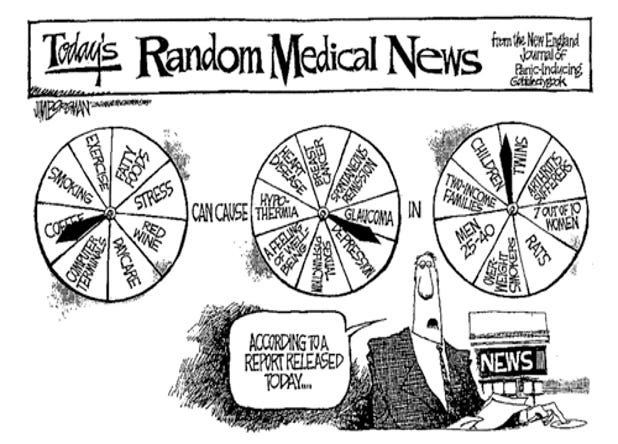
And keep giving appropriate side eye to observational studies of things we eat and drink causing some health outcome decades later.
Stay well,
Jenn
Great piece. Made me laugh as I sit here sipping my second coffee of the day.
The world needs more articles like this, not just debunking observational studies but explaining *why* confounding could invalidate them entirely.
That said, there is RCT evidence that coffee is protective against afib.