
RSV immunizations are keeping lots of babies out of the hospital
Some good news for parents and for tiny lungs

TL;DR:
Real-world data show dramatic declines in infant hospitalizations following the introduction of RSV immunization over the last two seasons.
Babies can be protected either through maternal vaccination during pregnancy or with monoclonal antibodies given shortly after birth.
RSV season typically runs from early October through the end of March, so it’s not too late to get protection for your young baby this season.
RSV immunization is still recommended for all US infants

While RSV (respiratory syncytial virus) can feel like a “common cold” for many, it can quickly turn dangerous for babies and older adults. RSV is the leading cause of hospitalization in babies in the US and typically causes more than 2 million doctor visits in kids under age 5 each year.
RSV immunization is still recommended for all US infants
Earlier this month, the US federal government amended the recommended childhood vaccination schedule, but recommendations for RSV immunization in infants remain essentially unchanged.
All babies < 8 months old whose mother did not receive the vaccine during pregnancy are recommended to receive the RSV monoclonal antibody. High-risk children, such as those with chronic lung disease, should receive a second dose at ages 8-19 months.
Babies have TWO different options for getting protected from RSV. The US CDC and the American Academy of Pediatrics recommend:
Maternal vaccination (brand name Abryvso) between 32-36 weeks gestation—maternal antibodies to RSV are then passed to the baby and protect them for up to 6 months during their first (and most dangerous) RSV season.
“Passive vaccination” for the baby: Monoclonal antibodies such as nirsevimab (brand name Beyfortus in the US) and clesrovimab (brand name Enflonsia in the US) are recommended for all babies <8 months whose mothers did not receive the RSV vaccine during pregnancy. The dose should be given to babies shortly before the RSV season, or within 1 week after birth if born between October and March (see timing chart, below).
Protection with nirsevimab is also recommended for children ages 8-19 months who are at high risk for severe RSV disease entering their second RSV season. This includes: children with chronic lung disease due to prematurity, immunocompromise, complications from cystic fibrosis, and American Indian or Alaska Native children.
Currently there is no recommendation for RSV vaccination for children 8 months or older who are not at increased risk of severe RSV disease or for any children older than twenty months old.
Side note: Monoclonal antibodies provide direct, immediate short-term protection when babies are most vulnerable. Monoclonals are different from a vaccine, which teaches the immune system how to recognize a pathogen and make its own antibodies against it. The word “immunization” means the process of making a person resistant to an infectious disease, so it covers both traditional vaccines and direct administration of antibody protection like monoclonals.
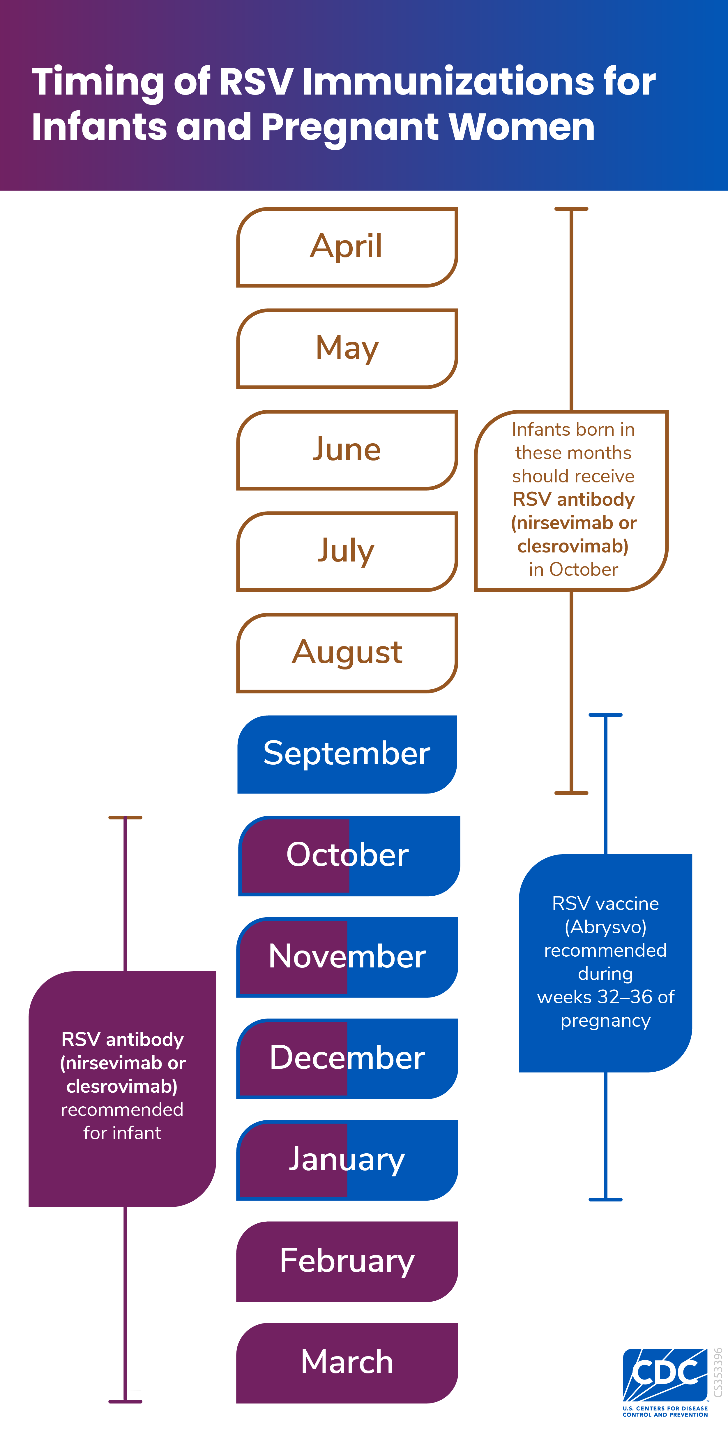
Source: US CDC
While there seemed to be a change to RSV immunizations in the new US guidelines, the only shift was to move RSV to the category intended for “certain high-risk groups or populations” rather than recommended for “all” children.
But–- RSV immunization is still recommended for ALL babies < 8 months whose mothers didn’t receive the vaccine (because they are high risk), so the effective recommendation is unchanged.
Impressive real-world impact
While these vaccine schedule changes may cause some confusion for expectant or new parents, it’s important to highlight just how huge the RSV vaccines have already been for keeping babies from getting seriously ill.
A systematic review of 27 studies evaluating the roll-out of RSV monoclonal antibodies in infants through February 2025 found an overall 83% reduction in the odds of RSV-related hospitalization and an 81% reduction in the odds of intensive care unit admission in infants ages 0-12 months. These are remarkable effect sizes, reflecting tens of thousands of babies who avoided severe illness and hospitalization in their first year of life because of this new protection.
RSV can also damage young lungs beyond the acute infection, increasing the risk of developing asthma and wheezing, and of subsequent hospitalization for lower respiratory infections. A recent study from Galicia, Spain looked at whether the one dose of newborn RSV protection carried over to reduced hospitalization risk in the baby’s second RSV season. They found that newborn RSV vaccination was associated with an 86% reduction in RSV-related hospitalizations compared to previous seasons, and that protection persisted in the baby’s second season, with a 55% reduction in RSV-related hospitalizations, even as the circulating subtype of RSV changed. This is really good news—a one-time dose doesn’t seem to just delay hospitalizations that would have happened eventually. Instead, avoiding RSV in your first most vulnerable year seems to lower the risk of subsequent severe disease, possibly through a “lung-sparing” effect of avoiding damage from early infection.
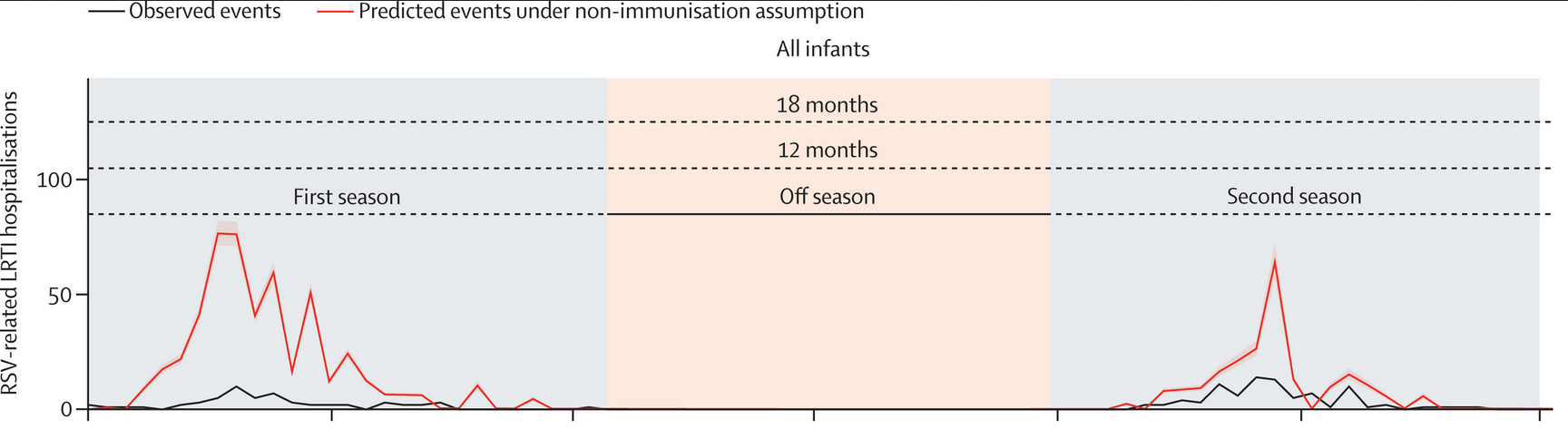
Figure: Weekly comparison between observed RSV-related hospitalisations in 2023-24 (black line) and expected levels based on pre-vaccination cohorts (red line) in Galicia, Spain. Source: Razzini, Josefina L., et al. The Lancet Infectious Diseases (2026).
As data on the real-world effectiveness of the RSV vaccines rolls in from many different countries, it’s becoming clear that these new RSV immunizations could be a game-changer for infant health.
(The RSV vaccine for older adults has also significantly reduced hospitalizations, so good news around).
The Bottom Line
RSV immunizations are already showing incredible real world effectiveness, keeping thousands of young babies out of the hospital and preventing potentially long-lasting damage to tiny lungs.
RSV immunization is still recommended and accessible in the US.
If you are pregnant or have a young infant, make sure to get that protection for your baby!
Stay well,
Jenn
This post is a collaboration with Data for Health, Those Nerdy Girls, and the Dartmouth International Vaccine Initiative (https://sites.dartmouth.edu/divi/).