
The Cancer Vaccine We Already Have
The HPV vaccine is amaze amaze amaze

With the HPV vaccine, the future is already here.
TL;DR:
The HPV vaccine prevents multiple types of cancer in both men and women.
Rates of cervical cancer have dropped dramatically for younger women since the vaccine’s introduction.
The HPV vaccine has a very strong safety record over 20 years and hundreds of millions of doses.
HPV vaccine coverage in the US (and worldwide) is still lagging where it could be.
As I’ve written about before, the once-tidy boundary between infectious and chronic disease has gotten much blurrier over the last few years. With new evidence of links between Epstein-Barr Virus and multiple sclerosis and the shingles vaccine and dementia, it’s clear we have a lot more to learn.
A Virus that Causes Cancer
One of the first discoveries of an infectious cause of a chronic disease was Human Papillomavirus (HPV). HPV is extremely common, infecting cells of the skin and mucus membranes and spread by skin to skin sexual contact. Most people will get an HPV infection in their lifetime, but often have no symptoms and quickly clear the virus. Some will experience genital warts. But some people will have a “persistent infection” that sticks around and causes trouble.

A link between sexual activity and cervical cancer had been noted for a long time (incidence was higher among married women and absent in nuns), but the specific causal factor was not known. German virologist Harald zur Hausen first isolated HPV viral DNA in cervical tumor tissue in 1983, finding that two high-risk HPV subtypes were present in most cervical cancers (he won the Nobel Prize in Medicine for this discovery in 2008).
HPV causes its trouble by disabling key tumor suppressor proteins in our cells, taking away our built-in brakes on cancer growth. Persistent HPV infection can result in a slow progression from normal to pre-cancerous to cancerous cells over many years. In 2000, Maura Gillison found similar evidence for a causal link between HPV and certain head and neck cancers, via the same biological mechanism.
It’s important to note that HPV causes virtually all cervical cancers-- HPV is a necessary but not sufficient cause for cervical cancer – meaning the cancer cannot develop in the absence of HPV, though having HPV does not mean cancer will automatically develop. But the good news is this means these cancers are almost entirely preventable— no HPV, no cancer.
HPV also causes about 90% of anal cancers, and a substantial share of cancers of the vulva, vagina, penis, and oropharynx (cancer of the head and throat). There are close to 50,000 HPV-associated cancers reported in the US each year.

The HPV vaccine didn’t come in time to save Eva Peron, who sadly died (“entered immortality”) from cervical cancer at age 33. (Pic from my visit to Buenos Aires, 2014).
A Cancer Prevention Vaccine
The first HPV clinical trials found that the vaccine was around 98% effective at preventing cervical precancerous lesions in women without a prior HPV infection. In the broader population that included women with prior exposure, efficacy was lower-- around 44%. This difference illustrates the crucial point that the vaccine works best when given before any HPV exposure.
Subsequent trial data also showed that the vaccine prevented HPV infection and the development of HPV-related genital lesions in boys and men, supporting the extension of HPV vaccination recommendations to males in 2011 after initial FDA approval in females 2006. In the US, the HPV vaccine is now licensed for all people up to age 45. The current Gardasil 9 vaccine protects against nine strains of the human papillomavirus (HPV), including the ones that cause cancer and genital warts.
Because cancer takes many years or decades to develop, it wasn’t a practical endpoint for randomized clinical trials. The trials showed that the HPV vaccine reduced the risk of HPV infection, genital warts, and pre-cancerous lesions over 3-4 years of follow-up. But now, nearly 20 years after the vaccine’s introduction, we have some remarkable real-world data on the vaccine preventing cancer itself.
Some Jaw-Dropping Real World Data
The first big real-world study to show the vaccine prevents cancer, not just precancerous lesions, came out of Sweden in 2020, where national population registries allowed researchers to track nearly 1.7 million women. They found a 88% reduction in cervical cancer incidence among girls vaccinated for HPV before age 17.
This was followed by data from England showing an 87% reduction in cervical cancer in women offered the vaccine at age 12–13 compared to those unvaccinated.
But it gets even better. In Scotland, there have been ZERO cervical cancer cases among women vaccinated at age 12–13 after the routine vaccination program started in 2008.
In Australia, a similar triumph- NO CERVICAL CANCER CASES were diagnosed in women aged <25 years through 2021.

These types of national studies provide some of the best evidence that HPV vaccination works in the real world. When vaccination is rolled out through a national programme with high uptake, researchers can compare the cervical cancer risk for cohorts of women who were eligible for the new vaccine compared to those who were never eligible due to when they were born. This is a cleaner comparison than studies that can only compare outcomes of people who choose to be vaccinated or not (since we know that choice may be correlated with many other health decisions).
As an example, a recent study published in JAMA Oncology found that men and boys who received the HPV vaccine from ages nine to 26 were around 50% less likely to develop cancers of the head and neck, esophagus, anus, or penis. This study examined electronic health records in the US and used propensity score matching–a fancy statistical way of trying to make sure the treatment and control groups were as similar as possible except for their HPV vaccination status. This is a reasonable thing to do when you don’t have randomized data, but it is more susceptible to potential bias than experimental or quasi-experimental designs.
So we should be close to eliminating HPV-associated cancers….right?
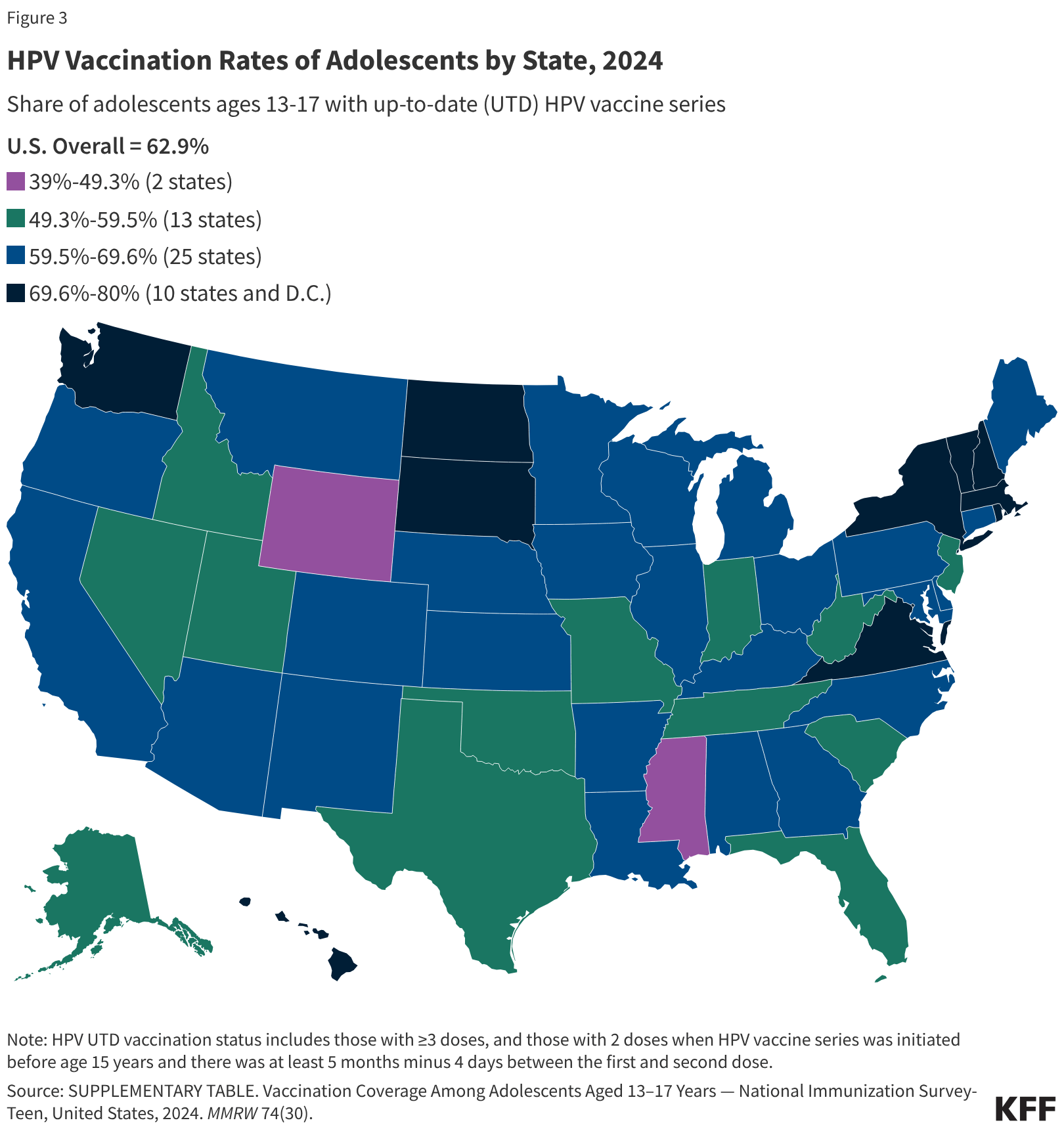
Alas (as we’ve learned all too well lately), the existence of life saving technologies doesn’t mean that people will use it. Only 62.4% of US adolescents aged 13-17 were up to date on their HPV vaccinations in 2024, and this coverage varied widely geographically, with a low of 39.1% in Mississippi and a high of 79.8% in Massachusetts. This coverage is lower than for other vaccinations recommended for the same age group, such as Tdap (91%). Closer to 78% of US adolescents have had at least one dose of the HPV vaccine, so we can consider it good news that *most* people seem willing to get vaccinated…but we can do better.
In England, HPV vaccine coverage among adolescents has fallen from almost 90% prior to the pandemic to around 75% in the most recent year.
Why is uptake not higher?
You might assume that a cancer-prevention vaccine would fly off the shelves. But since HPV is a sexually transmitted infection, giving it to adolescents became controversial in some circles, leading to a proliferation of misconceptions we can happily set straight:
Common HPV Vaccine Myths
❌ Myth 1: Boys don’t have a cervix, so they don’t need the HPV vaccine.
✅ Reality: Both men and women can be infected with and transmit HPV.
The HPV vaccines prevent HPV-related cancers of the head and neck, anus, and penis in men (and genital warts). In fact, there are similar numbers of HPV-associated cancers diagnosed in men and women each year. Read here about the story of Jason, who was diagnosed with stage 4 HPV-related tonsil cancer in his 40s, resulting in radical surgery and 7 weeks of chemotherapy and radiation.
❌ Myth 2: Pap smears are also effective for preventing cervical cancer, so there is no need for a vaccination.
✅ Reality: Pap smear screening detects pre-cancerous cervical lesions or cancer, which then need to be treated (a physically and emotionally taxing process). HPV vaccination prevents cancer from developing in the first place.
I think most of us would rather prevent a spark from ever catching fire than call the fire department to battle our house fire after the smoke detector goes off. What’s more, screening doesn’t catch all cancer cases and is not available for the other non-cervical cancer types caused by HPV, which means they are often caught at a later, more dangerous stage.
❌ Myth 3: HPV vaccines are new, so there are no safety and efficacy data on long-term side effects.
✅ Reality: HPV vaccines are incredibly safe. We now have 25 years of experience with HPV vaccines, with several hundred million doses distributed worldwide.
A recent systematic review of 274 studies by the Vaccine Integrity Project found no evidence linking HPV vaccination to serious adverse events or long term conditions.
❌ Myth 4: Children are not sexually active so there is no need to vaccinate them early.
✅ Reality: The vaccine is most effective BEFORE exposure to the virus, so choosing the ages prior to sexual initiation gives the most protection.
There is also evidence of a better immune response to vaccination under age 15 compared to older peers.
❌ Myth 5: There is no use getting the HPV vaccine if you are already sexually active.
✅ Reality: Although the vaccine is the most effective before HPV exposure, it can still protect against HPV different HPV strains you haven’t yet contracted.
❌ Myth 6: HPV vaccination increases risky sexual behavior and promiscuity.
✅ Reality: We don’t need to speculate-data show that receiving the vaccine at the recommended age doesn’t lead to earlier or increased sexual activity.
(I admit I never really followed the logic of this one. Is there any teenager in the world who would get a shot at the pediatrician and think “finally, my license to have sex!!.”)
❌ Myth 7: The HPV vaccine can cause chronic pain or fatigue syndromes.
✅ Reality: Thorough reviews have found no links between the HPV vaccine and chronic pain conditions, including chronic fatigue syndrome or complex regional pain syndrome (CRPS).
The most common side effects of the HPV vaccine are temporary such as soreness at the injection site, headache, and fatigue. CRPS and fibromyalgia-like conditions often emerge in adolescence, which can make the timing feel suspicious even when there is no causal relationship.
❌ Myth 8: The HPV vaccine can cause infertility.
✅ Reality: Despite early case reports, large population-based studies found no evidence that the HPV vaccine is associated with infertility. To the contrary, the vaccine helps protect future reproductive health from potential damage due to HPV-related cervical precancers and cancers
Vaccinate Your Family tells the story of Lauren who developed cervical cancer at age 23, leading to a radical hysterectomy. She notes the vaccine had just become available when she was 14, but no one recommended it to her.
More to Learn
Is one dose enough?
While we already have mountains of evidence that the HPV vaccine is remarkably safe and effective, that doesn’t mean the science is done. One current question is whether one dose may give similar protection as two or three doses.
There is evidence that one dose provides equivalent protection against HPV infection and pre-cancerous cervical lesions compared to two doses, but how long this protection lasts and whether this extends to other HPV-associated diseases, including head and neck cancer, and genital warts, is not known. No studies have directly evaluated single-dose versus two-dose protection at non-cervical sites, so this is a research gap yet to be filled.
An effective one-dose vaccination could be valuable both practically and financially, so we will watch that emerging science with interest. England as already adopted a one-dose recommendation, along with Estonia, Ireland, and Spain, while other European countries still recommend a two or three dose schedule.
For now, US recommendations remain for two doses if vaccinated under age 15 (due to a stronger immune response), and three doses if vaccinated after age 15.
What about older adults?
While the HPV vaccine is currently licensed up to age 45 in the US, more adults above age 45 are asking about HPV vaccination, especially people who find themselves newly single later in life. While insurance may not cover the vaccine at older ages, it’s worth speaking to your clinician if you are over age 45 and expect to have new sexual partners. For more on this, read Dr. Jen Gunter’s post on why she got the HPV vaccine at age 52.
There is also some suggestive evidence (discussed by the This Week in Virology team here) that HPV vaccination may help clearance of the virus in women who are already HPV-positive, and also reduce progression of pre-cancerous cervical lesions and recurrence of high-grade lesions after surgical removal. This has led some countries (including Italy and Spain) to recommend HPV vaccination for women being treated for moderate to severe precancerous cervival lesions. Hopefully there will be more experimental data to come on this potential use of the vaccine as an enhancement to treatement.
Bottom Line: The HPV Vaccine is amaze, amaze, amaze
The dream of a cancer prevention vaccine is HERE…. let’s use it!
Stay well,
Jenn
This post is a collaboration with Data for Health, Those Nerdy Girls, and the Dartmouth International Vaccine Initiative.